For decades, the Nigerian dream had a familiar script: go to school, obtain a degree, then find a stable and lucrative job. That script is failing. Every year, thousands of young Nigerians pass through universities across the country only to join the ranks of the unemployed, while employers in construction, manufacturing, healthcare support, agriculture, and the digital economy cannot find workers with the practical skills they need.
This mismatch cannot be considered a minor inconvenience. It is a red flag. And right in the middle of the discussion on what to do about it is one underfunded, under-appreciated system; Technical and Vocational Education and Training (TVET).
When the Formula Stops Working
In the past, having a university degree was almost a guaranteed entry point to opportunity. That is no longer the case. The numbers make it plain. According to a Guardian Newspaper report, Nigeria produces approximately 600,000 graduates annually. Yet over 80 million Nigerians remain unemployed, a figure that exposes a formal sector simply unable to absorb graduates at the rate they are produced.
Many graduates also find themselves without the skills that employers actually need; technical troubleshooting, equipment handling, digital tools, project execution, and hands-on problem-solving. These are not academic competencies. They are vocational ones, and the gap between what graduates offer and what the labour market demands is widening.
On the other hand, the informal and technical sectors, such as electrical work, welding, plumbing, auto repair, garment manufacturing, renewable energy installation, agro-processing, IT support and so much more, are facing a persistent shortage of skilled labour. It is not that the work does not exist. It is because the education system has not caught up with where the job opportunities are.
A degree still has value. However, on its own it is no longer enough. What increasingly determines whether a young Nigerian can find a job, start a business, or build a livelihood is no longer just the certificate on the wall, but the skill in the hand.
Skills as a National Development Imperative
It is time to change how Nigeria thinks about vocational education. TVET has long been treated as a fallback for students who could not make it through the academic route. That perception is not just outdated; it is costly.
Skills development is not a consolation path. It is essential infrastructure.
Countries like Germany, South Korea, and more recently Rwanda and Vietnam did not industrialise on the strength of university degrees alone. They built deliberate systems of technical training that fed directly into their industrial and service sectors. Skilled labour built their factories, powered their energy systems, maintained their infrastructure, and eventually drove innovation from the ground up.
The Federal Government has taken a step in this direction. Through the Federal Ministry of Education, a free nationwide TVET programme was launched in 2025, targeting nearly one million Nigerian youths across 2,600 training centres. The curriculum is 90 percent practical, covering 28 key sectors including GSM repair, plumbing, livestock production, fashion and garment making, and modern farming. Each participant receives a monthly stipend to support their training, and plans are said to be underway to connect graduates directly with employers through a national job-market portal being developed with World Bank support.
This is a significant policy signal. Its success, however, will depend on whether training centres maintain quality, whether industry partnerships are sustained, and whether graduates receive the support needed to convert skills into livelihoods.
Nigeria’s broader ambitions in manufacturing, renewable energy, construction, agriculture, and technology will not be realised through policy alone. They will be realised by welders who can work to specification, technicians who can maintain solar installations, artisans who can produce to export quality, and young entrepreneurs who can turn a trade into a sustainable business.
Neglecting TVET is not merely a gap in the education system. It is a gap in the nation’s development strategy.
Unlocking the Demographic Dividend
Nigeria has one of the youngest populations in the world, with a median age below 18 years. This is frequently described as a demographic dividend, the economic potential of a large, active working-age population. But a demographic dividend is only a dividend if that population is equipped to work.
Without deliberate investment in practical, market-relevant skills, that advantage inverts. A generation of young Nigerians with certificates but without competencies, searching for jobs a formal sector cannot produce in sufficient numbers, is not a dividend. It is an opportunity being steadily missed.
To convert population size into national prosperity, Nigeria must modernise TVET institutions and connect training providers directly to industry. It must change the social narrative around skilled trades, expand access for young women, out-of-school youth, and rural communities, and integrate entrepreneurship and digital literacy into training so that graduates are equipped not just to find jobs, but to create them.
Where Olivehill Development Initiative Comes In
At Olivehill Development Initiative, we recognise that sustainable development must be built from the ground up, through people who are equipped, healthy, and economically empowered. Skills development sits firmly within that mission.
If the younger generation of a community has no pathway to dignified, productive work, no means to earn a living wage or contribute meaningfully to society, then that community cannot be considered healthy or resilient, regardless of how many certificates it holds.
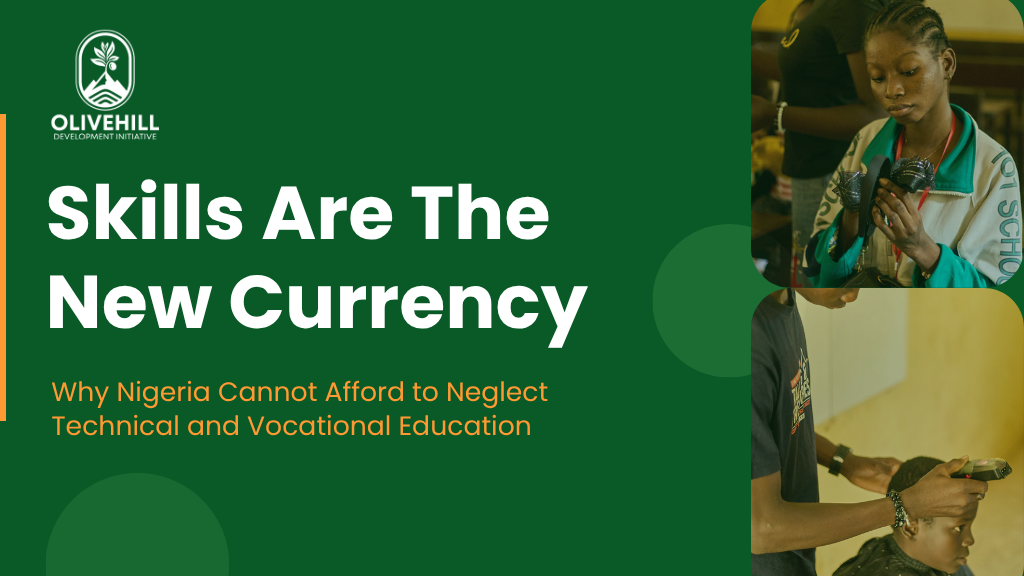
This conviction is what drives TVET Teens, our vocational training programme designed to equip young Nigerians with practical, market-relevant skills. In August 2025, in collaboration with TOM Camp Abuja, we delivered our inaugural training at Government Science Technical College, Abuja, reaching 540 teenagers across fourteen skills including coding, digital marketing, solar energy, photography, and pastry making. It was a first step, and a deliberate one. TVET Teens is our commitment to ensuring that access to practical skills is not a privilege but a foundation that more young Nigerians can build on. This August 2026, we are excited to host another edition, equipping more teenagers with the skills they need to thrive.
The Bottom Line
Skills are the new currency. In a labour market where degrees are abundant but practical competencies are scarce, it is the people, communities, and countries that recognise that shift and act on it that will pull ahead.
Technical and vocational education cannot continue to be Nigeria’s last resort. The cost of neglect is not hypothetical. It is measured in the underemployment of a generation and a demographic dividend that remains unclaimed.
The time to invest in skills is now; deliberately, structurally, and urgently.